








Everyone talks about raising ‘smart’ kids, but here’s the real question: what does being smart even mean in a world that changes every single day?
It’s not just about memorizing facts and scoring high on tests; it's about developing adaptability, thinking critically, reasoning logically, and solving problems independently. Currently, we live in an age where knowledge is readily available at our fingertips; now the real challenge is learning how to utilize it wisely.
At Satya School, Sector 49, Gurgaon, one of the best schools in Gurgaon, this vision is brought to life through the LogIQids program, a unique initiative designed to nurture 21st-century learners. The program goes beyond textbooks, helping children develop the skills they’ll need to thrive in academics and in life.
In this article, we’ll explore why logical reasoning matters in education, how global learning trends are moving away from rote learning, and how the LogIQids program at Satya School is shaping smarter, future-ready kids.
Also Read | Beyond Academics: Helping Students Discover Their Ikigai at Satya SchoolWhy Logical Reasoning Matters in Education

Logical reasoning is more than just solving puzzles; it's about sharpening the mind to think clearly and act decisively to make better decisions in real life.
According to a recent study by the World Economic Forum (2023), critical thinking and problem-solving are among the top 5 skills every child will need to succeed in the future workforce. This makes it clear that learning logical reasoning at a young age is not just useful, it's essential. Here's what students gain:
-
A strong foundation for academics: Reasoning skills support subjects like Mathematics, Science, and Computer Programming, as they require logical thinking.
-
Critical and analytical thinking: It teaches children how to break down problems into smaller steps, analyse them, and approach them with structured solutions.
-
Confidence and independence: Solving reasoning tasks helps students build the self-assurance to face challenges on their own.
-
Future-readiness: With AI and automation taking over simple tasks, these skills will prepare children not only for competitive exams but also for adapting to real-world complexities.
How Global Education Trends Are Moving Beyond Rote Learning
Our traditional education system has long been criticised for its over-reliance on rote memorisation. According to recent statistics, only 29% of students in grades 6 to 12 feel that their school environment fosters a real learning experience, underlining the need for a shift in educational methods. The schools now are adapting, and it is evident in several initiatives, for instance, the National Education Policy (NEP) 2020 emphasizes the importance of developing higher-order cognitive capacities, such as critical thinking and problem-solving.
Schools and universities are increasingly incorporating activities that require analytical thinking, such as debates, group discussions, and case studies. This approach not only enhances understanding but also prepares students for diverse and dynamic career paths.
-
Shift toward skills over content: Many national and international curricula are emphasizing competencies critical thinking, collaborative learning, and creative expression, rather than just memorization.
-
Project-based, inquiry-based learning: Students are asked to explore, ask questions, and experiment, rather than simply receive information.
-
Use of formative assessment and differentiated learning: Teachers are focusing more on feedback, including helping students in their zones of proximal development, adjusting instructions to student levels.
-
Technology-assisted and blended learning: Edtech tools are used to personalize learning, to reinforce skills outside of traditional classroom hours.
-
Benchmarking & global standards: Schools are looking beyond the local for comparison - international assessments, olympiads, etc. to see where their students stand in a broader context.
What Is LogIQids & How It Works
Here’s how schools structure the LogIQids programme to bring these ideas into everyday learning:
|
Feature |
Details |
|
Scope & Integration |
The logical reasoning and aptitude work is embedded into the regular curriculum so that students get continuous exposure. |
|
Personalised Worksheets & Brain Workouts |
Students get worksheets and daily “brain workout” exercises. These are differentiated meanings tailored to the level of the learner. |
|
Variety of Media / Physical & Online |
A mix of physical sheets (20) and online differentiated aptitude/mind-skills sheets (30) so children can practice in more than one mode. The online part allows a flexible pace and revisits. |
|
Mentorship & Feedback |
Students have access to an online mentor to clarify doubts, a dashboard for tracking progress, and regular reports. This gives both students and teachers/school visibility into strengths and areas to work on. |
|
Benchmarking & Olympiad |
Students take part in the International Logic Olympiad to see how they stack up globally. There are stages: a free first stage, then a final stage (optional and chargeable). Recognition (certificates, trophies, medals) is given to top performers. |
|
Skills Developed |
It helps develop and refine 21st-century skills like logical reasoning, problem-solving, spatial skills, verbal reasoning, and analytical thinking. These are honed and developed over a period. |
Skills That Set Students Apart
Through the LogIQids program, students develop core traits that will shape them into leaders of tomorrow. How these skills don’t just help in academics but lay the groundwork for lifelong success:
-
Analytical thinking: Breaking down challenges into solvable steps.
-
Problem-solving under pressure: Staying calm and creative when faced with obstacles.
-
Innovation and originality: Looking beyond the obvious to find fresh solutions.
-
Collaboration and teamwork: Working together to share ideas and solve tasks.
-
Strong communication skills: Presenting solutions with confidence, whether on paper or in front of peers.
Check Out | Redefining Learning Spaces: The Impact of Innovation on Education
Satya School: Empowers Future-Ready Learners
Satya School, Gurugram, affiliated to CBSE and IB, delivers a 100% Class X & XII board pass rate with toppers scoring up to 97.6%. Ranked among the best CBSE schools in Gurgaon, it is a Microsoft Showcase School and winner of the Education World Emerging High Potential School Award. With national medals in Taekwondo, Skating, Equestrian, and student honors like District Water Ambassador, Satya champions both academic and co-curricular excellence.
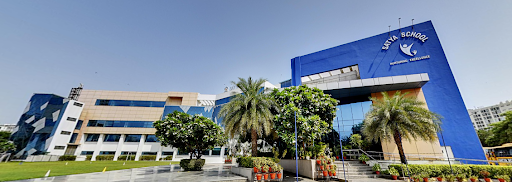
The LogIQids initiative at Satya School is more than an academic add-on; it’s a reflection of the school’s commitment to preparing children for the real world. By embedding logical reasoning into daily learning, Satya School ensures that students not only excel in exams but also grow into independent thinkers, confident problem-solvers, and innovative leaders.
The program’s success highlights the school’s broader vision: nurturing a learning environment where knowledge meets skills, and where education empowers children to go beyond what they know and explore what they can become.
Satya School takes pride in shaping future-ready learners, and the LogIQids program is a testament to how education can truly prepare students for life. After all, in today’s world, smart learning is what makes smarter kids.
For more information on this and other such schools in the area, check out this list of the best schools in Gurgaon.

 as a preferred source on