









Introduction
A school charges X amount for the academic year 2024-25; however, for the academic year 2025-26, it shows almost a 9-10% increase in the fees. The purpose of this report is to help parents understand and predict the changes in their child's fees for a particular school.
To understand and analyze the pattern of how fees change over the years, the Ezyschooling Fee Index considers a list of over 6800 schools.
Key Findings
.png)
- The average total annual fee of an Indian private day school is ₹69,800 on the median
- The fee of an Indian private day school that follows the IB Board is 9.8 times more than that of CBSE
- The priciest city for private day schooling is Gurgaon, while the cheapest city is Jabalpur, where Gurgaon is 3.7 times more costly than Jabalpur
- The total annual average (median) fee of a private boarding school is ₹222,800
- 82.9% of the year-on-year checks show a changed fee in the schools
- The average total cost of schooling in a Day private school from nursery to class 12 is ₹14.6L (median). This means that a child who starts nursery classes today will be costing his family 14.6L by the time that the child reaches class 12th, 14 years from now.
Cite as: Ezyschooling Fee Index, 2026. Based on 119,629 school-class-session records across 6,879 schools and 42 Indian cities. Published [August 2026] by Ezyschooling.
Methodology
Scope: 119,629 total entries x class x session records, 6,879 schools, 42 cities, and sessions from 2021-22 onward. It combines information from Nursery to Class 12, with the data considering the boards as well as the location of these schools.
We calculated total fees based on the following metrics:
- The sum of all 76 individual fee components recorded for a school
- Covers tuition, admission, transport, boarding, examination, and every other head
- Verified to equal that sum exactly in all 119,629 records
- Every component annualized to its billing cycle first (monthly × 12, quarterly × 4)
Important factors to point out:
- To understand the changes in the school fees, we decided to pick information from the academic years mentioned above.
- Every ranking and conclusion drawn by city, by board, and by fee type is limited to categories with enough records to be statistically reliable (300+ for cities, 200+ for boards).
- The information is based on the fees data provided by schools or available on the school’s website. The inferences drawn are from the data that our team has collected.
- The deviation between the highest and lowest fees of a school is big. Thus, to make sure that the average fees come down to the closest number, we have considered the median as the average.
- Most of the data works on the private schools' numbers; however, government schools are noted where relevant but excluded from headline comparisons.
- In the sheet below, the word "school-years" will be mentioned quite frequently, which is a unit of measurement designed for this study.
School-Year= One school, One class, compared across two back-to-back years.
Transparency and Composition of a School Fee Bill
Transparency
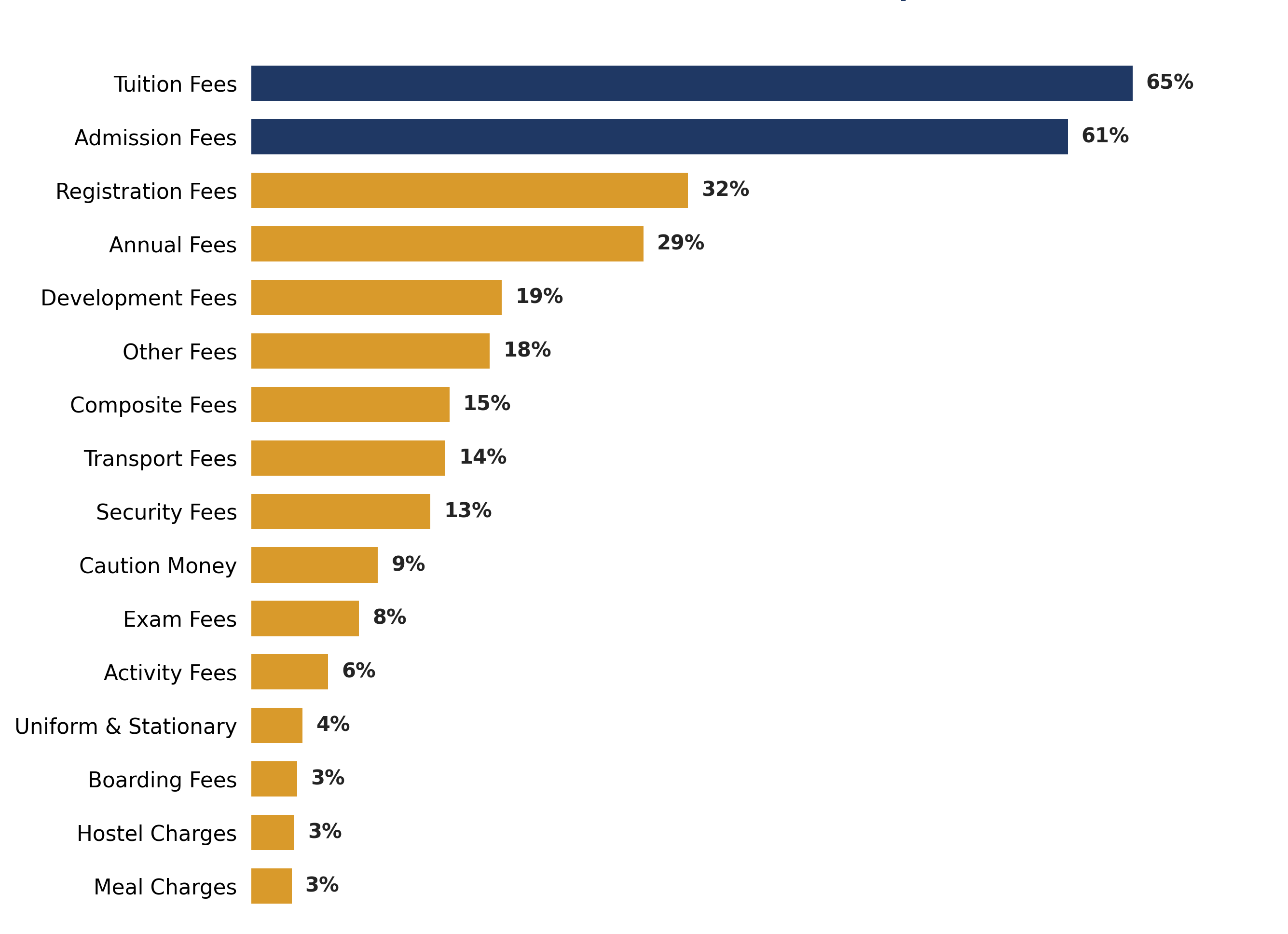
According to multiple state rules and even the rules of the Central Board of Secondary Education, schools are mandated to show fees in a publicly available space and on their website. The stats show the following fees and their presence on the records.
The two near-universal components:
- 65.4% of records show school tuition fees for classes at a school.
- For admission fees, there are 60.6% of records.
However, after this, there is a steep decline in the percentage of data accessible.
- Registration fees have a presence of 32.4% in all records.
- Annual fees are only present in 29.1% of total stats.
- Development fees are taken only in 18.6% of school classes.
- Transport fees were highlighted by only 14.4% of school classes.
- Security fees are present for 13.3% of school classes.
- Caution Money is only present for around 9.4% of school classes.
The bundling exception:
- 14.7% of records show a single composite fee instead of a breakdown itemized fee.
So to summarize, it is very clear that while the rules require fees to be present on easily accessible platforms, not all schools follow them.
Components of Fees
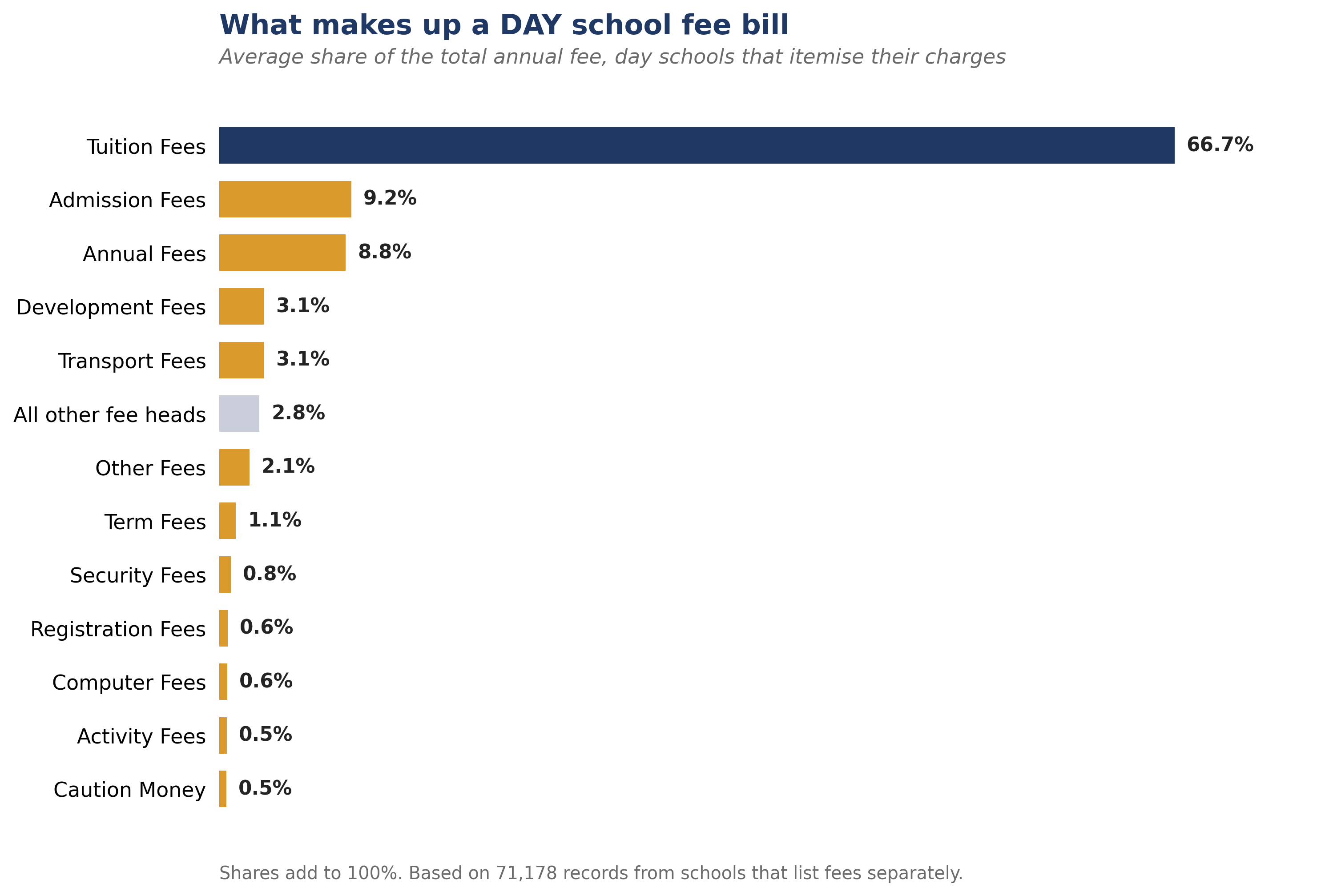
After establishing that not all schools create an itemized version of the fees, it is important to understand that for those schools that do itemize their fees, the composition of different elements comes together to form the "Total Fee." To give you a clear example, let's say that a school's total fee for a year is 60k; the tuition fees of the school is 25% of the total fees, transport is 20% of the total fees, and the total lab cost is 15%. The cost of sports is the rest, 40%.
|
Fee Component |
Share |
|
Tuition Fees |
66.7% |
|
Admission Fees |
9.2% |
|
Annual Fees |
8.8% |
|
Transport Fees |
3.1% |
|
Development Fees |
3.1% |
|
Other Fees |
2.1% |
|
Term Fees |
1.2% |
|
Security Fees |
0.8% |
|
Registration Fees |
0.6% |
|
Computer Fees |
0.6% |
|
Activity Fees |
0.5% |
|
Caution Money |
0.5% |
|
All other heads |
2.8% |
|
City |
Tuition |
Admission |
Annual |
Transport |
Development |
Else |
|
Lucknow |
75.00% |
11.20% |
2.80% |
2.50% |
0.70% |
7.80% |
|
Ghaziabad |
72.70% |
13.40% |
2.80% |
2.90% |
2.50% |
5.80% |
|
Delhi |
72.40% |
1.60% |
9.50% |
3.30% |
6.00% |
7.40% |
|
Pune |
69.60% |
7.80% |
6.40% |
0.60% |
1.80% |
13.80% |
|
Faridabad |
67.30% |
15.60% |
7.50% |
2.30% |
3.20% |
4.10% |
|
Bangalore |
64.50% |
8.20% |
14.40% |
2.90% |
1.30% |
8.70% |
|
Noida |
62.00% |
18.30% |
4.00% |
5.50% |
1.00% |
9.20% |
|
Indore |
58.50% |
10.50% |
12.90% |
9.50% |
0.30% |
8.30% |
|
Gurgaon |
58.30% |
14.10% |
9.90% |
4.50% |
2.70% |
10.50% |
|
Kolkata |
47.80% |
26.00% |
7.50% |
2.00% |
3.10% |
13.70% |
|
Fee Component |
Share |
|
Tuition Fees |
36.6% |
|
Boarding Fees |
15.2% |
|
Annual Fees |
13.3% |
|
Hostel Charges |
13.0% |
|
Admission Fees |
6.9% |
|
Other Fees |
2.1% |
|
Security Fees |
1.7% |
|
Imprest Money |
1.5% |
|
Meal Charges |
1.3% |
|
Development Fees |
1.0% |
|
Caution Money |
1.0% |
|
Term Fees |
0.9% |
|
Registration Fees |
0.8% |
|
Transport Fees |
0.8% |
|
Plus 6 more heads |
~3.8% |
Predictable Vs Unpredictable Fees
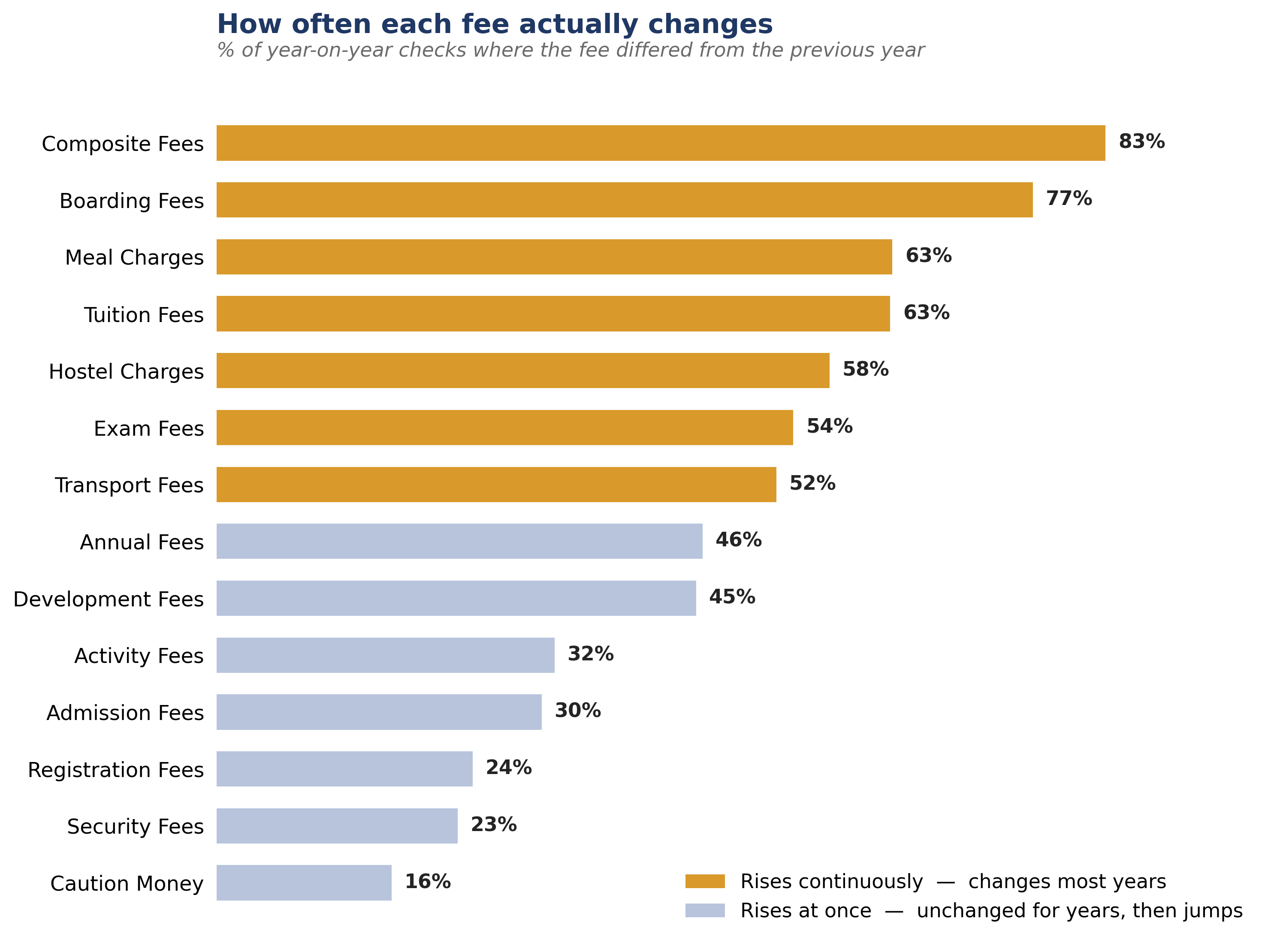
- When compared with the fees of previous years for the same class, 82.9% of school-years showed a revision. This implies that while it is not always rising, it changes quite frequently.
- Whenever the fee is revised, the increment is at an average of 7.94%.
- Day schools have an increment of 8.00%, and boarding schools have an increment of 7.02%.
The increment in fees is categorized by those that increase consistently and those that show a sudden inflated increment.
Predictable fees are revised often, in modest steps:
- Composite fees are revised in 83% of school-years.
- Tuition fees are revised in 63% of school-years.
To conclude, a patterned and predictable fee increment happens at around 8-10% each time.
But an unpredictable fee hike is seen at intervals, which cannot be concluded as it does not follow a pattern.
- The security fee is revised in only 23% of school years, but whenever the fee moves, the typical jump is at 25%.
- Registration fees are revised in 24% of school-years, with a 15% increment when they move.
- Caution Money is revised in only 16% of school-years, with an 18% jump when they move.
That is around two to three times the size of a typical tuition revision. This explains a couple of things for the general audience:
- An increase in the tuition fee happens in a renewal notice, meaning that it is anticipatory.
- But a deposit increase appears once, unannounced, and with an offer for admission.
- It lands at the exact moment a family has the least room to compare or negotiate.
Do fees get affected if you change the location?
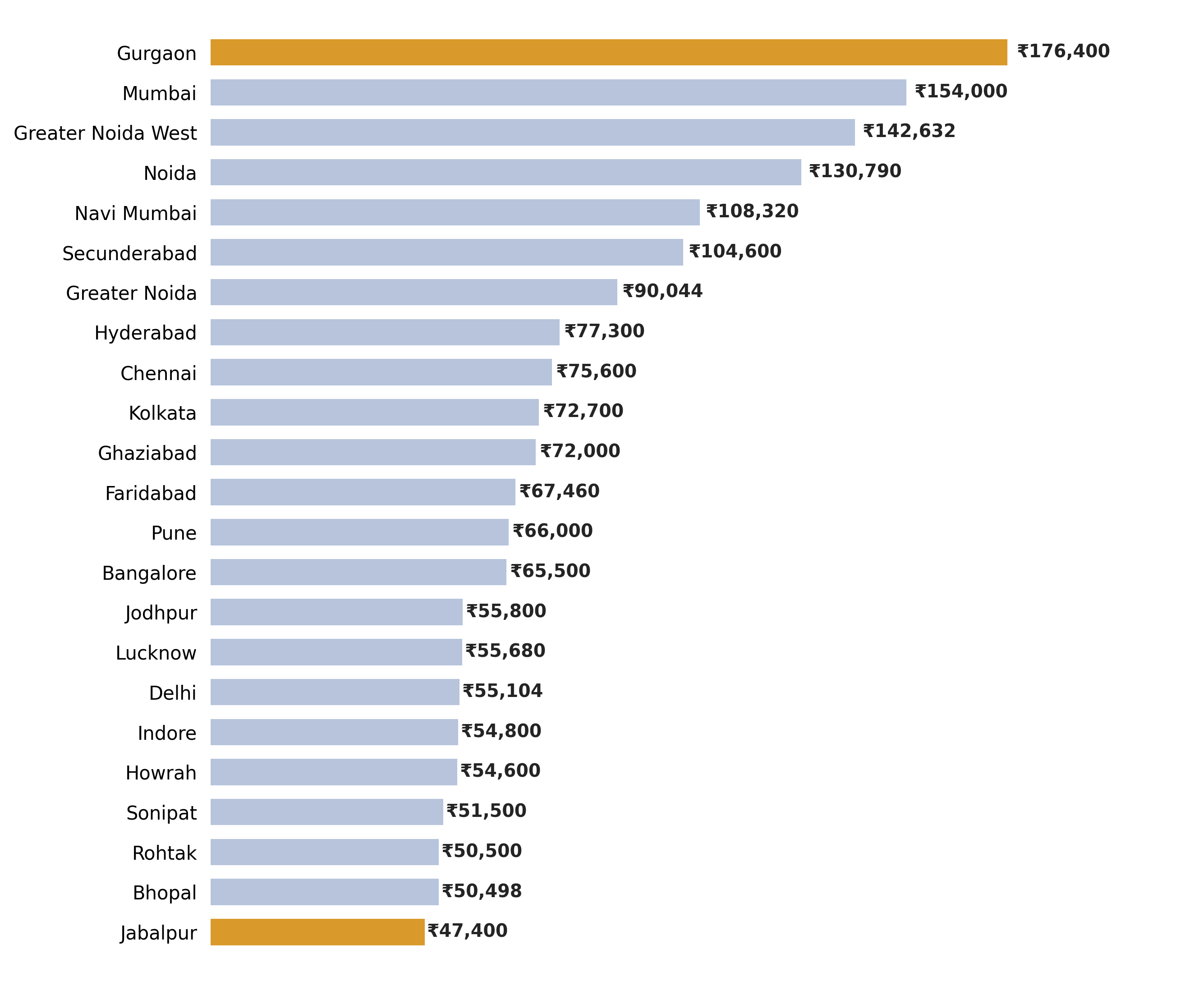
The spread: ₹176,400 in Gurgaon down to ₹47,400 in Jabalpur. This means that even for the same year, the median shows a 3.7x difference between the two regions.
Top of the table:
- Average fees of schools in Gurgaon: ₹176,400
- Average fees of schools in Mumbai: ₹154,000
- Average fees of schools in Greater Noida West: ₹142,632
- Average fees of schools in Noida: ₹130,790
The ranking does not follow city size or importance of the city in the country.
- Gurgaon sits above Mumbai.
- Noida and Greater Noida West both come in well above Bangalore (₹65,500) and Pune (₹66,000).
Delhi is a clear outlier:
- Despite having the most number of schools, the National Capital shows an average of ₹55,104.
- The most noticeable differentiation is that it is less than a third of the neighboring city of Gurgaon, a short drive away.
The takeaway: Delhi and Gurgaon are not one market. Proximity says nothing about price.
Comparison of different boards on the basis of fees
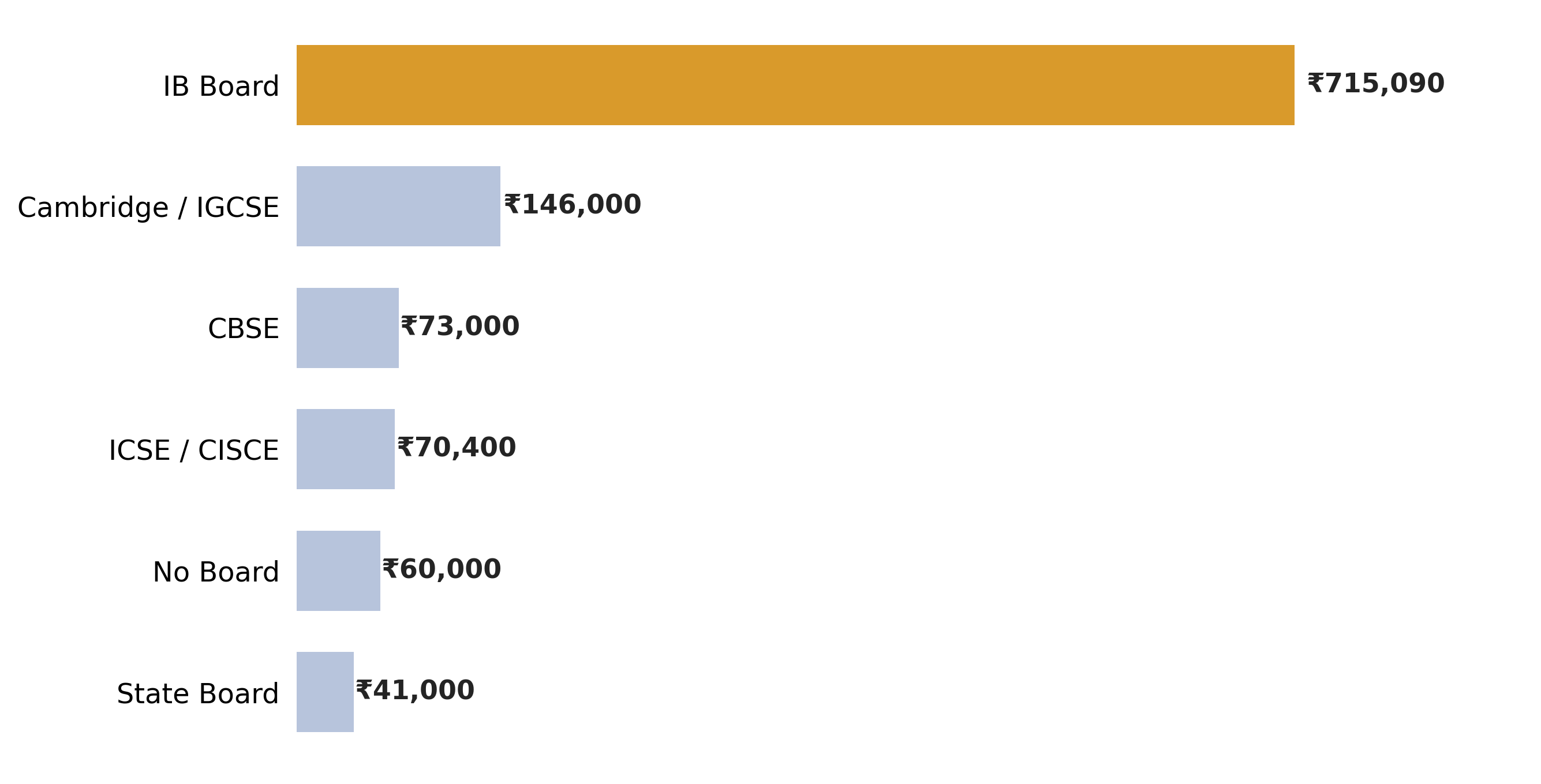
Of every factor examined until now, the school board is the single strongest predictor of cost, with IB Board fees running far above CBSE and every other board.\
|
Board |
Median Total Annual Fee |
|
IB Board |
₹715,090 |
|
Cambridge / IGCSE |
₹146,000 |
|
CBSE |
₹73,000 |
|
ICSE / CISCE |
₹70,400 |
|
No Board |
₹60,000 |
|
State Board |
₹41,000 |
International curricula sit in a different tier entirely, with the Cambridge/IGCSE being exactly 2x of CBSE and IB nearly 10x. The gap from State Board to IB is more than seventeenfold.
CBSE vs ICSE Fees: Why the Answer Depends on Your City
A surprising intervention to understand the price difference between CBSE vs ICSE, where nationally, CBSE (₹73,000) and ICSE/CISCE (₹70,400) look identical but are completely dependent on the location.
Where ICSE costs more: In Gurgaon and Pune, an ICSE school runs 36-51% above a CBSE one, as is the trend.
Where it costs less: However, in Bangalore, Kolkata, and Howrah, ICSE comes in 13-34% below CBSE.
The likely reason: While CISCE/ICSE is the established mainstream option with the examples of Bangalore and Kolkata, it includes plenty of ordinary mid-market schools. Where it is comparatively rare, as in Gurgaon and Pune, it skews toward premium schools that chose it deliberately.
What this means for a parent: There is no fixed "ICSE premium" to budget for. The board's cost relative to CBSE depends on how common it is in your city.
|
City |
CBSE |
CISCE/ |
State Board |
Cambridge/IGCSE |
IB Board |
No Board |
|
₹83,460 |
₹73,000 |
₹42,500 |
₹119,000 |
₹500,000 |
₹60,422 |
|
|
₹55,200 |
— |
₹26,135 |
— |
₹522,400 |
₹45,600 |
|
|
₹69,550 |
₹94,690 |
₹34,621 |
₹235,500 |
— |
₹57,000 |
|
|
₹161,460 |
₹243,500 |
₹51,700 |
— |
₹10,86,596 |
₹198,400 |
|
|
₹72,000 |
₹70,245 |
₹45,100 |
— |
— |
₹50,100 |
|
|
₹80,400 |
₹68,370 |
₹33,600 |
— |
— |
— |
|
|
₹66,960 |
— |
₹18,100 |
— |
— |
— |
Scope and grouping
- The data only mentions day schools, so that the IB premium is not an artifact of boarding costs.
- Covers schools offering a single board. Around 5% offer more than one, typically an Indian board alongside an international curriculum, and are excluded because their fees cannot be attributed to one board. These schools are notably more expensive, with an average of ₹172,200.
Fees of the school as the classes go up?
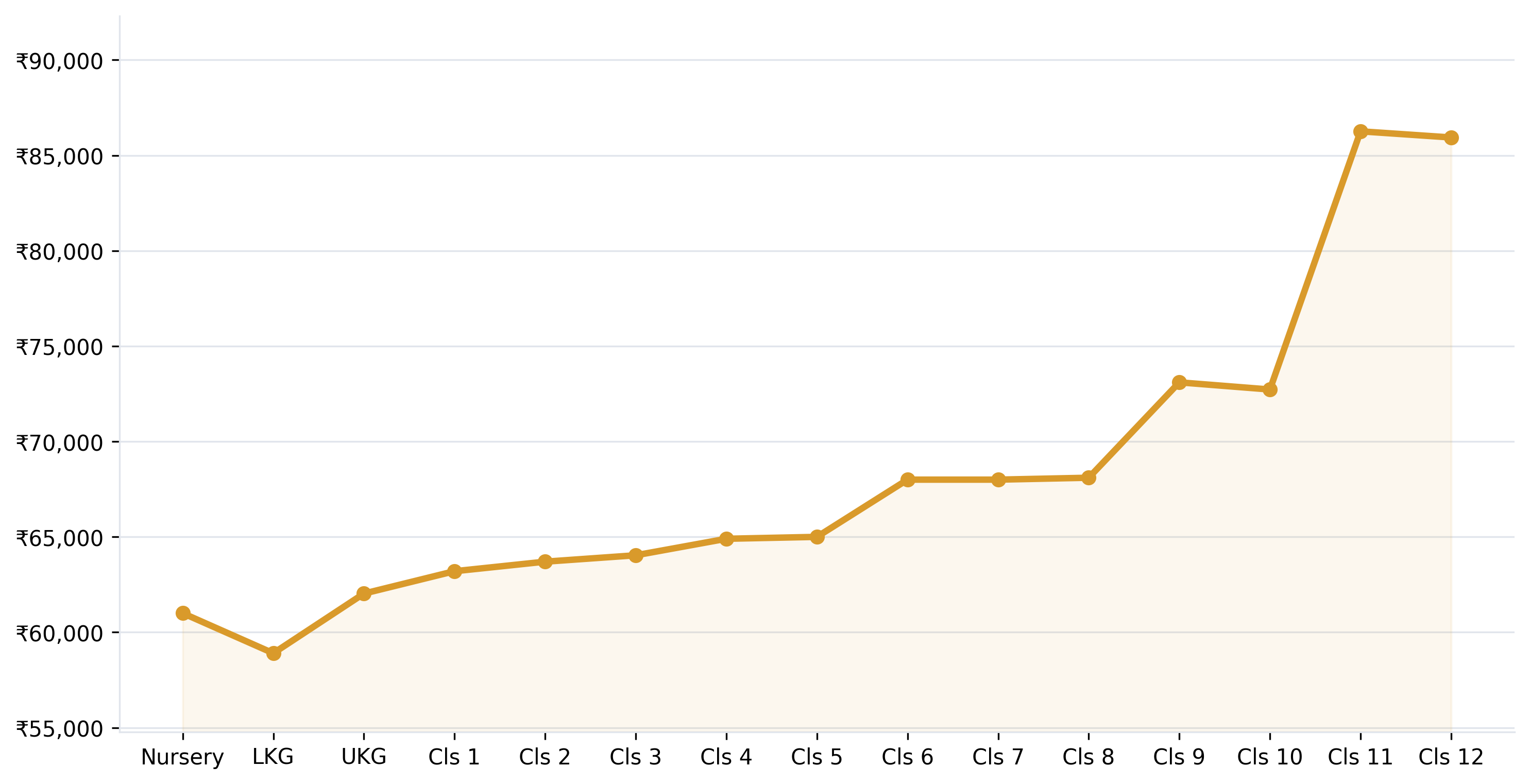
The overall climb: A fee of ₹61,000 in Nursery rises to about ₹86,000 by Class 11-12, which makes it roughly 41% across the school career.
Two acceleration points:
- In Class 9, the average moves from ₹68,100 to ₹73,100.
- In Class 11, the jump is sharper, ₹72,725 to ₹86,259, as students move to their streams in senior secondary.
One counterintuitive detail:
- LKG is the cheapest year of all at ₹58,900.
- Cheaper than Nursery before it (₹61,000) and UKG after it (₹62,028).
- Entry level and cheapest are not the same thing, even between adjacent years.
Boarding, Online, or Day
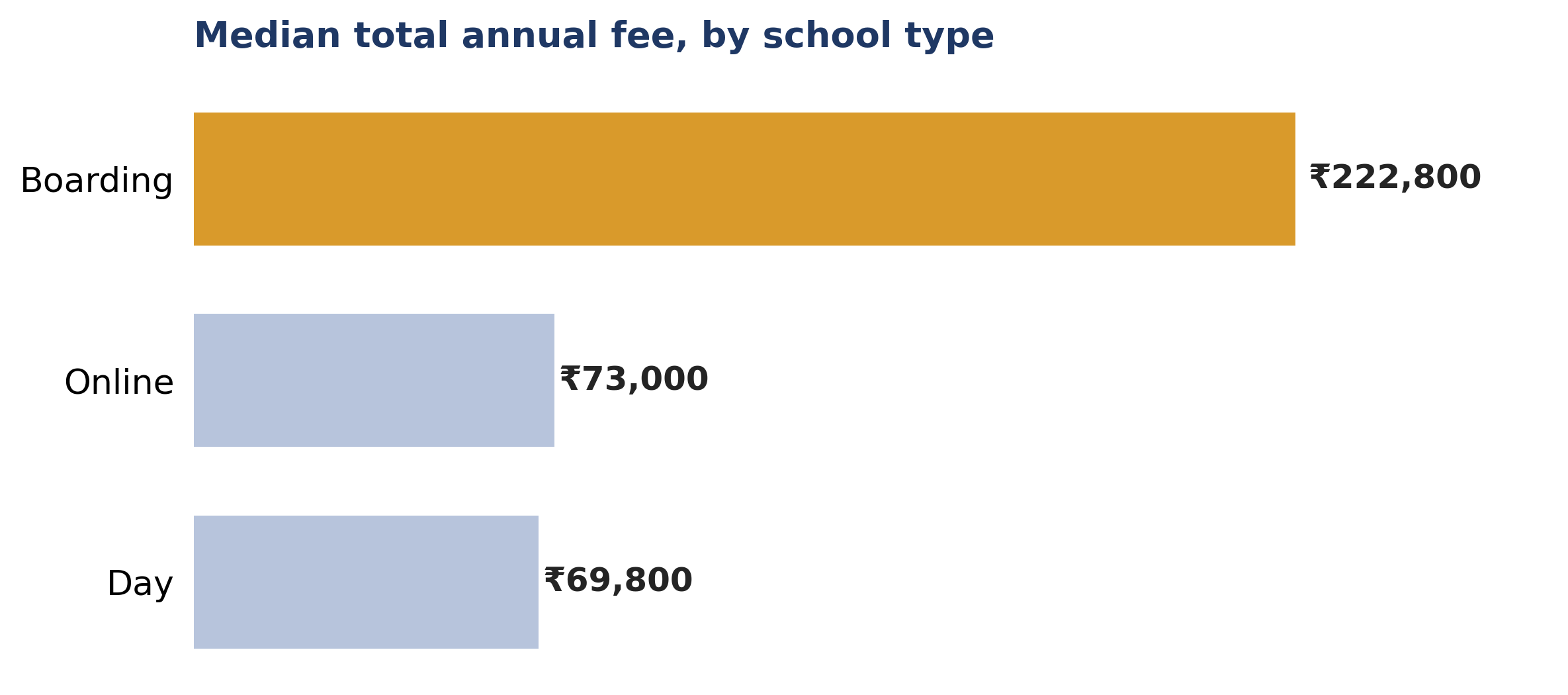
The three formats separate cleanly:
|
School Type |
Average School Fee |
|
Boarding |
₹222,800 |
|
Online |
₹73,000 |
|
Day |
₹69,800 |
The reason behind the huge difference between boarding and others is the huge boarding fee difference.
- Boarding fees have an average of ₹186,000
- Hostel charges have an average of ₹120,000
- Meal charges have an average of ₹31,200
For a boarding family, tuition is a minor share of the real bill.
A caveat on online schools:
- The category contains only 18 schools
- It splits between premium international-curriculum schools and considerably cheaper domestic ones
- The figure should not be read as a finding about online schooling in general
The Real Cost of Schooling in India
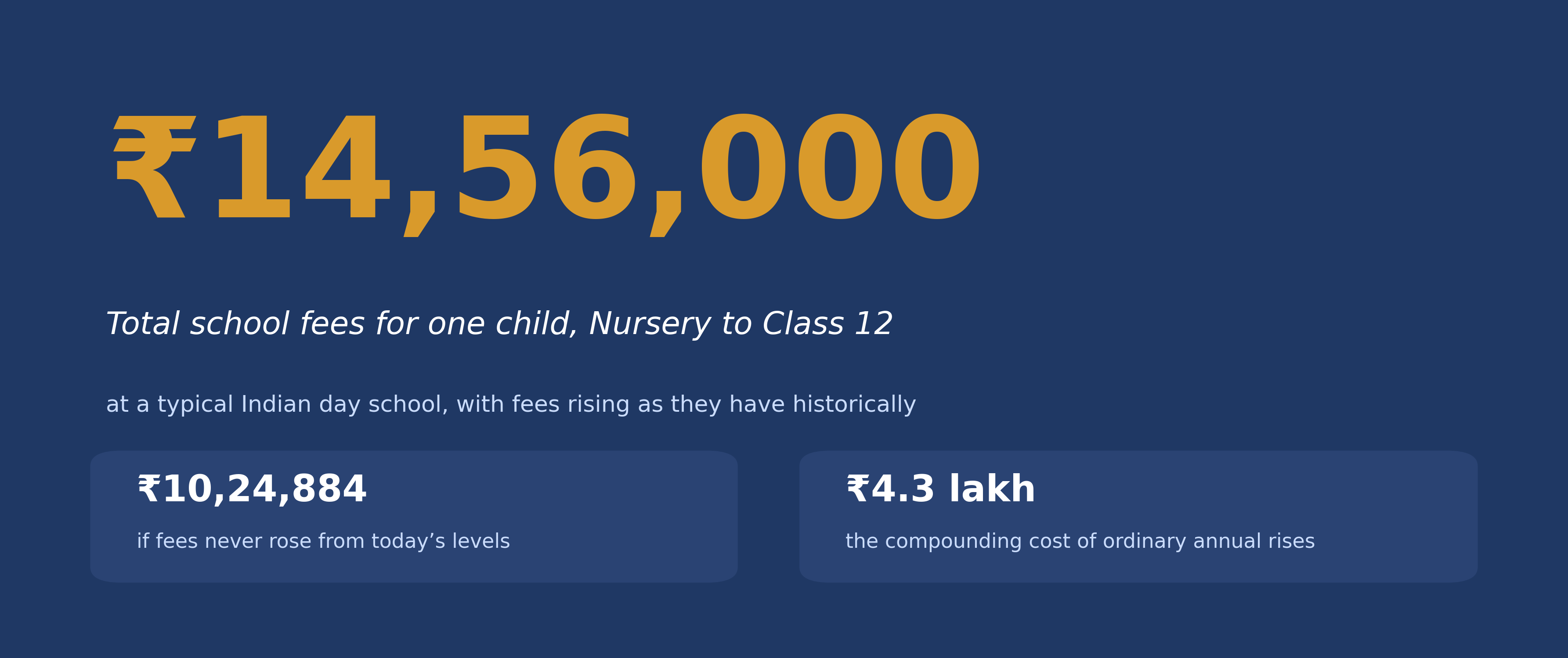
To understand the true cost of schooling in India, this section combines the fee at each grade, plus the annual increases along the way.
‘A child starting nursery at a typical Indian day school this year will cost their family approximately ₹14,56,000 in total school fees by the time they complete Class 12.’
For contrast:
- If fees never rose from today's levels: ₹10,24,884
- The difference, which is roughly ₹4.3 lakh, comes because of the compounding cost of ordinary annual increases
- Accumulated quietly over more than a decade
Note: The above covers the numbers for day schools. A boarding education, at more than three times the annual cost, sits in an entirely different range.
Takeaways
1. Expect a School Fee Hike Almost Every Year
- Fees changed in 82.9% of school-years, with an average change of 7.94%.
- Treat an annual rise of roughly 8% as the base case, not the worst case.
2. Ask when the deposits were last revised.
- Security fees, caution money, and registration fees change in fewer than a quarter of school-years.
- But they rise 15-25% when they do and are charged at admission.
- Ask the school directly, and get the answer before committing.
3. Compare total fees, not tuition.
- Roughly one school in seven bundles everything into a single composite figure.
- No two schools itemise identically, and because of that, a tuition figure alone tells you very little.
4. Recognize that the board is the biggest financial decision.
- The CBSE vs. ICSE gap depends on your city; thus, there is no fixed premium to budget for.
- The gap between either and an international curriculum is a multiple, not a margin; additionally, it compounds across every year of schooling.
About Ezyschooling
Ezyschooling is an Indian school discovery and admissions platform that helps parents find, compare, and apply to day, boarding, and online schools across the country. Alongside the platform, Ezyschooling provides free counselling to help families navigate school selection and the admissions process.
The Ezyschooling Fee Index is built from the platform's own school fee database, compiled from information provided directly by schools and published on official school websites. This edition covers 119,629 school-class-session records across 6,879 schools in 42 cities.
 as a preferred source on