







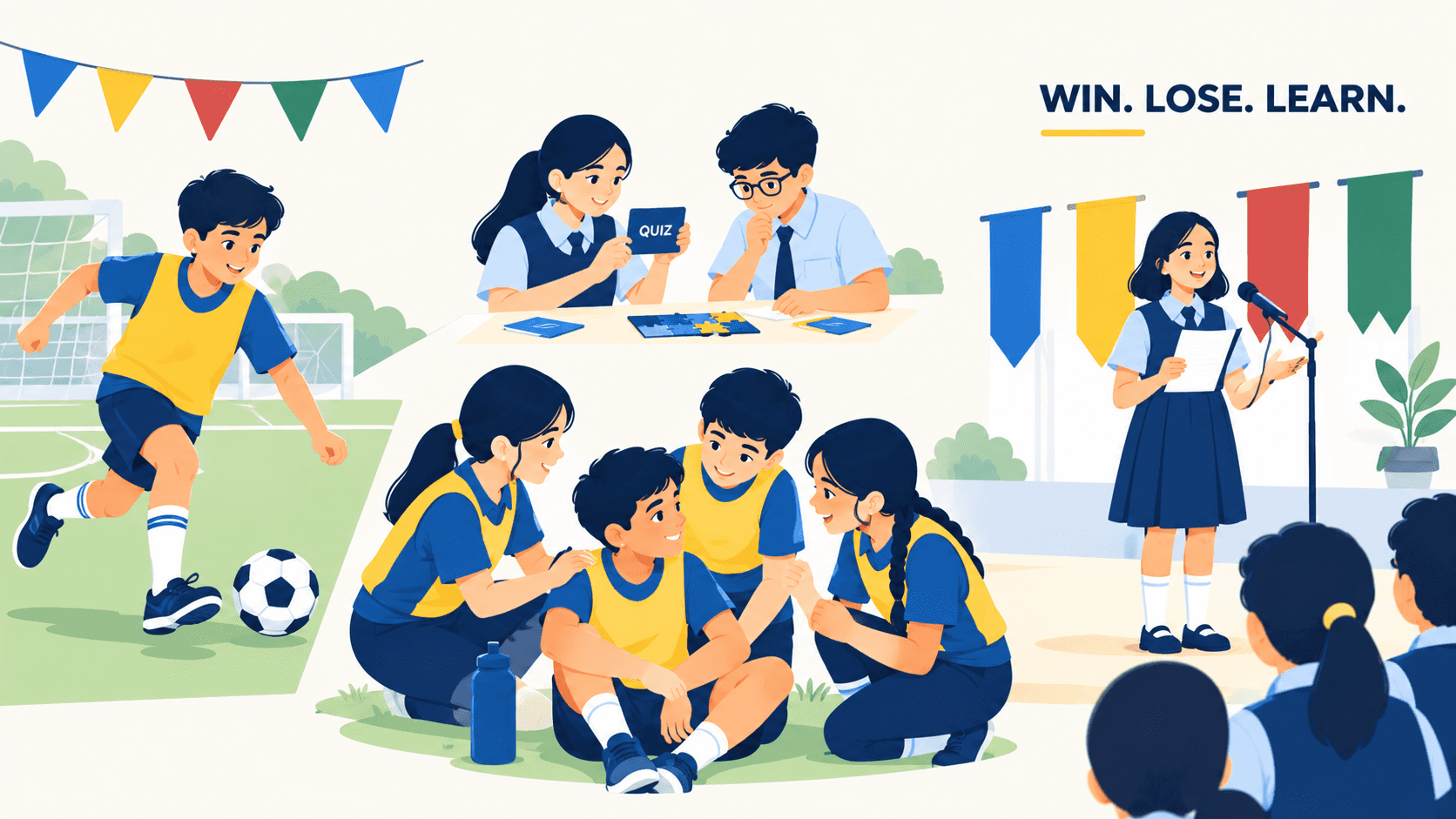

A child can score 95% on an exam and still struggle to handle a disappointing result. They can know every answer on a worksheet but freeze when their team loses a match. This is one reason parents exploring the top schools in Greater Noida and nearby areas increasingly look beyond report cards. At G.D. Goenka Public School, for example, inter-house activities create regular opportunities for children to compete, participate, and learn from outcomes. The larger question, however, is not about winning. It is about what children learn when the result does not go their way.
Competition Is Useful When It Is Not About Proving Who Is Better
Competition itself is not the problem. The real difference lies in what a child thinks the competition means.
Imagine two children entering a drawing contest. One thinks, “I want to try a new idea and see how well I can do.” The other thinks, “If I don't win, everyone will know I am not talented.” Both are in the same contest, but they are having completely different experiences.
Psychologists often distinguish between mastery goals and performance goals. A mastery goal focuses on improving a skill, while a performance goal focuses on looking better than others. The American Psychological Association notes that mastery goals are generally more useful when students face challenging learning material and recommends emphasizing individual effort rather than constant social comparison.
This is why healthy competition should sound more like, “Can I improve?” than, “Can I beat everyone?”
|
Healthy competition |
Corrosive comparison |
|
“I improved my timing.” |
“I am slower than him.” |
|
“Our team worked better today.” |
“Their team is better than ours.” |
|
“I learned from the mistake.” |
“I am bad at this.” |
|
“I will try again next time.” |
“There is no point trying.” |
Why Losing Can Be Part of Learning
A report card usually tells a child where they stand at the end of a period. A competition gives them something different: immediate feedback.
Consider a student who misses the final question in a quiz, drops a catch during cricket practice, or forgets a line during a poem recitation. The result is visible immediately. There is also another opportunity coming soon.
That repeated cycle matters.
Research on competition among young children suggests that competition can support enjoyment and perceived competence when challenges are appropriately designed. A 2024 study of 6–7-year-olds found that children improved and enjoyed activities more when they were given achievable, individualised targets rather than simply being left without a clear target.
This creates a useful pattern:
Try → receive feedback → adjust → try again.
A child who never wins may actually learn something important through this process. They discover that losing one event does not mean losing their identity. They can practice, change their approach, and find another area in which they can contribute.
The same idea appears in mathematics competitions, sports and even everyday activities such as learning to cycle. A difficult first attempt does not become a permanent label. It becomes information for the next attempt.
Also Read | Importance of Entrepreneurship Learning in Schools
The Child Who Never Wins Still Needs a Place to Shine
This is where the design of a competition matters more than the trophy.
If a school repeatedly celebrates only the fastest runners, highest scorers, or strongest performers, some children may gradually stop volunteering. But if competitions include different kinds of skills, participation becomes broader.
A child who does not enjoy football may love creative writing. A student who feels uncomfortable on stage may be excellent at mathematics. Another may not be the fastest swimmer but may contribute strongly to a team through strategy, encouragement, or preparation.
This is closely connected to self-determination theory, which highlights the importance of competence, autonomy, and relatedness in motivation. Competition can become less motivating when it feels controlling or makes success the only measure of worth, while well-designed challenges can provide useful information about competence.
For parents, this means asking a slightly different question after a competition.
Instead of asking, “Did you win?" Try asking:
- What did you enjoy doing?
- What was difficult this time?
- What would you change next time?
- What did you notice about how others prepared?
- What part did you play in helping your team?
These questions move the conversation from the podium to the process.
What Good Competition Looks Like in Everyday School Life
The strongest competitive environments do not make every event feel like a final exam. They create low-stakes, repeated opportunities to participate.
A child might lose a basketball game on Monday, help their house in a quiz on Wednesday and take part in a writing activity the following week. No single result has to define them.
That approach also gives parents an important role. When a child loses, immediately comparing them with the winner can turn a small disappointment into a judgment about ability. A calmer response is to acknowledge the feeling first and then discuss what the experience taught them.
|
If your child says… |
A helpful response could focus on… |
|
“I lost.” |
What happened and what they learned |
|
“Everyone was better than me.” |
Which skill do they want to practice |
|
“I don't want to participate again.” |
Whether they disliked the activity or the pressure |
|
“I want to try again.” |
What their next small goal could be |
The aim is not to remove disappointment. Children need to experience disappointment in manageable ways. Research on youth sports similarly points to the importance of environments where children can be challenged while still feeling safe enough to try, fail, and learn. PubMed Central (PMC)
Also Read | Key Features Parents Should Look for in a school in Greater Noida
How G.D. Goenka Builds Competition Around Participation

This idea becomes particularly visible at G.D. Goenka Public School, Greater Noida. According to the school's co-curricular activities page, inter-house activities are organized every week across sports and co-curricular areas. The listed sports include football, basketball, table tennis, volleyball, cricket, lawn tennis, karate, skating, and swimming. The school also lists eleven co-curricular categories, including creative writing, poem recitation, English, Hindi, Maths, Science, Social Science, Computer and Foreign Language enrichment, alongside group dance and patriotic group song.
That breadth is important because it gives competition more than one definition. A child who cannot sprint across a track can still represent their house through writing, language, mathematics, science, recitation, or another area of interest. The school's website also describes its approach as a balance of academics, sports, and extracurricular activities, with an emphasis on teamwork and leadership.
For parents comparing the best CBSE schools in Greater Noida, this kind of variety is worth noticing because participation does not have to depend on being the naturally fastest, loudest, or most athletic child.
The Bigger Lesson
Inter-house competitions can teach something a report card cannot easily capture: how a child behaves when the answer is not certain and the result is not guaranteed.
Winning teaches celebration. Losing teaches adjustment. Repeated participation teaches something even more useful: one result is only one result.
When schools create many opportunities to compete, participate, contribute, and try again, children get a safer place to practice resilience before life starts, asking them to use it every day.
To know more about other schools in Greater Noida, click on the link below
 as a preferred source on