








A classroom usually begins with a question that already has an answer. A makerspace can begin with a question that does not. That small difference can change how students think about learning. At one of the best schools in Gurgaon, Navriti School, the Makerspace Lab reflects this approach by giving students opportunities to move beyond simply understanding concepts and start experimenting with how those concepts can be used.
The idea behind makerspaces is simple: students learn by making, testing, improving, and sometimes getting things wrong. Instead of treating learning as something that ends when an exercise is completed, a makerspace turns it into an ongoing process of discovery.
When Learning Has to Survive Outside the Textbook
Many school concepts make perfect sense on paper but become more interesting when students have to use them.
For example, understanding measurements is one thing. Designing an object that must fit within specific dimensions is another. Learning about electricity is different from trying to create a simple working circuit. Reading about structures can become much more meaningful when students have to build something that can actually support weight.
This is where hands-on learning has an advantage. Students are not just recalling information; they are asking whether their understanding works in practice.
A makerspace creates room for this kind of learning. It allows students to turn an idea into something visible, testable, and improvable.
Read Further | Learning Beyond Textbook
The Most Valuable Part May Be the Failed Prototype
One of the interesting things about making is that the first attempt often does not work perfectly.
A structure may be unstable. A prototype may not perform as expected. A design may look good but fail when tested. A student may realize that an original idea needs to be changed completely.
In a traditional academic setting, mistakes can sometimes feel like evidence that something has gone wrong. In a makerspace, mistakes can become information.
- Why did the design fail?
- Which assumption was incorrect?
- What could be changed?
- Would a different material work better?
- How can the next version be improved?
These questions encourage students to look at problems differently. Instead of immediately searching for the correct answer, they learn to investigate the reason behind an outcome.
That habit can be useful far beyond a school project.
From “I Know” to “I Can Make It Work”
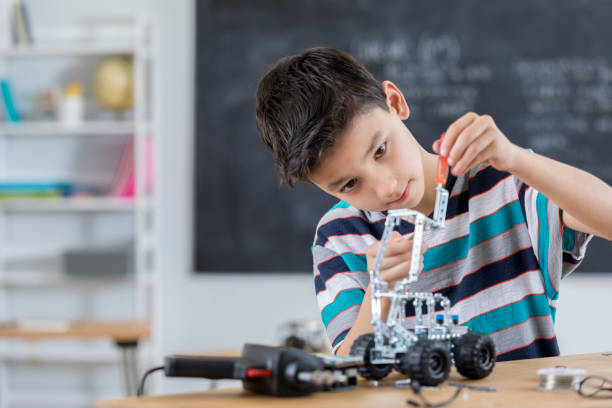
There is an important difference between knowing how something works and being able to use that knowledge.
A student may understand the basic principle behind a machine, for instance, but designing a simple working model requires several additional decisions. They may have to choose materials, plan the design, estimate measurements, test different possibilities, identify weaknesses, and modify the original idea.
This is where makerspaces can connect different areas of learning naturally.
Mathematics can become part of measurement and planning. Science can explain why a design behaves in a particular way. Technology can help with modelling or prototyping. Art and design can influence how a final product looks and functions. Communication becomes important when students need to explain their thinking to others.
Instead of learning these areas as completely separate subjects, students begin to see how they can work together around a real problem.
Makerspaces Also Give Students Permission to Be Curious
Not every useful project begins with a school assignment.
Sometimes a student simply wants to know whether an idea is possible. That curiosity can lead to experimentation, research, and eventually a project of their own.
This is particularly important because students do not all become interested in the same things at the same time. One may be fascinated by building mechanisms, another by design, another by coding, and someone else by finding practical solutions to everyday problems.
A makerspace can accommodate this variety because the starting point does not always have to be identical for everyone.
Personal projects can also teach an important lesson about ownership. When students choose what they want to explore, they have a reason to stay with a problem even when it becomes difficult.
Also Read | Experiential Learning and Robotics Make Children Curious
The Skill of Improving an Idea
Innovation is often presented as having a brilliant idea. In reality, useful innovation usually involves a lot of refinement.
The first version is rarely the final version.
Students who repeatedly design, test, and modify their work begin to understand this naturally. They learn that improvement is not a sign that the original idea was worthless. It is part of the process.
This can develop a practical form of critical thinking. Students learn to look at their own work objectively and ask what could be better.
That mindset can influence how they approach academic work too. Instead of seeing an answer as the end of a task, they may become more comfortable questioning, checking, and improving their thinking.
Collaboration Becomes More Natural
Making something can also change how students work with one another.
A group project requires more than dividing a worksheet into equal sections. Students may need to decide who will research, who will design, who will build, who will test, and who will document the process. Those roles can change as the project develops.
Someone who has one idea may have to listen to another person's suggestion. A disagreement may require the group to test both approaches. A technical problem may force students to combine their knowledge.
In this way, makerspaces can develop collaboration through a genuine need to work together rather than through a purely theoretical lesson about teamwork.
What a Makerspace Can Add to School Education

The strongest makerspace programs are not simply rooms filled with equipment. The real value lies in what students are encouraged to do with those tools.
A well-designed makerspace can create a bridge between curriculum concepts and practical challenges. It can give students opportunities to prototype ideas, explore questions that interest them, and develop solutions instead of only studying existing ones.
This is also why the connection between a makerspace and the academic curriculum matters. When making is treated as an isolated activity, its learning potential can be limited. When it is connected to classroom concepts, students can see why their academic knowledge matters.
At one of the best CBSE schools in Gurgaon, Navriti School, the Makerspace Lab is integrated with the academic curriculum as part of its wider approach to experiential learning. Students can work on curriculum-linked challenges as well as self-driven passion projects, giving them space to explore ideas through design, building, and prototyping.
The school's approach also introduces the idea of Genius Hours and Passion Projects, where students can pursue questions and ideas that genuinely interest them. The Makerspace, also referred to as the Disruption/Eureka Labs, provides a setting where these ideas can move from imagination towards tangible prototypes.
For students who are ready to explore further, Navriti also provides opportunities to collaborate with industry experts and gain exposure to research environments. This can help students understand that experimentation and problem-solving are not confined to school projects; they are part of how new ideas are developed in the wider world.
Ultimately, the value of a makerspace is not measured by how many impressive objects students produce. Its deeper value lies in the thinking that happens along the way. Students learn to ask better questions, test their assumptions, accept setbacks, work with others, and improve an idea instead of abandoning it.
That may be the most important lesson a makerspace can offer: An idea does not have to be perfect to be worth exploring. Sometimes, learning begins when students are given the freedom to find out what happens next.
To know more about other schools in Gurgaon, click on the link below
 as a preferred source on