




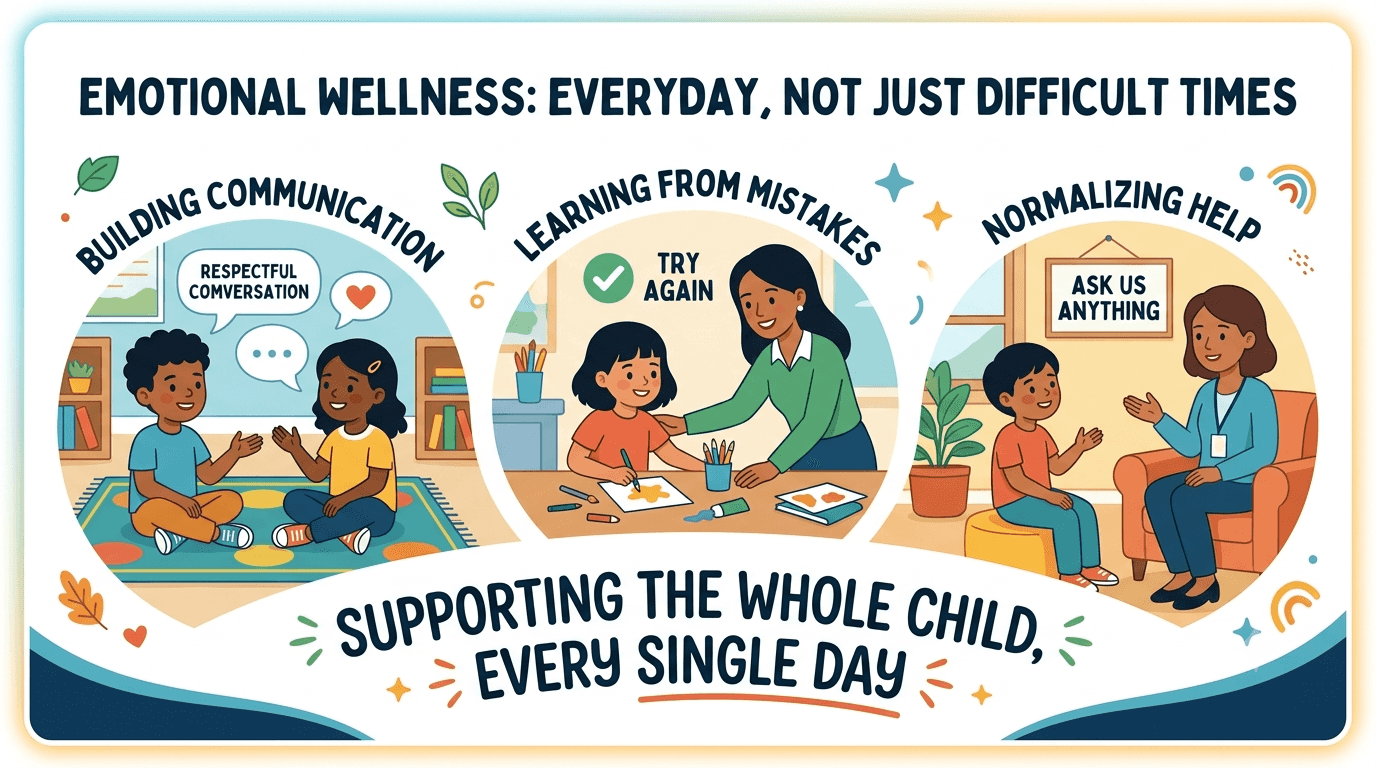

A child can be doing well in class, completing homework and enjoying school, yet still have moments when they feel worried, frustrated, left out, or unsure of themselves. Not every emotional struggle is obvious. Sometimes, a child simply becomes quieter after school or starts avoiding situations where they might make a mistake.
This is why emotional wellness should not be treated as something children need only when a serious problem appears. Grand Columbus International School, for example, includes emotional wellness within its broader approach to student support. Its focus on student well-being reflects an important idea: children need opportunities to understand and manage their emotions as part of everyday school life.
For parents looking for a Top School in Faridabad, emotional support can therefore be an important part of evaluating the overall school environment.
Also Read| Stress-Free Competitive Exam Prep Starts Early
What Does Emotional Wellness Mean for a Child?
Emotional wellness does not mean that a child is happy all the time. Children will naturally feel anger, disappointment, nervousness, embarrassment, and sadness.
What matters is whether they gradually learn how to recognise these feelings and respond to them in healthy ways.
A child developing emotional wellness may learn to:
- Put feelings into words instead of reacting immediately.
- Ask for help when something feels difficult.
- Handle disappointment without giving up quickly.
- Accept mistakes as part of learning.
- Listen to other people's feelings and perspectives.
- Communicate disagreements respectfully.
These are everyday skills. They can influence how a child behaves in the classroom, interacts with friends and responds to challenges.
Why Should Schools Support Emotional Wellness Every Day?
Children spend a significant part of their day at school. They learn lessons, work with classmates, receive feedback, participate in activities, and face situations that test their patience and confidence.
This makes school a natural place for emotional learning.
Small challenges can become learning opportunities
Imagine a student receiving a lower mark than expected. An adult could immediately focus on improving the score. But there is another conversation worth having:
What made the test difficult? How did you feel about the result? What could you try differently next time?
Similarly, a disagreement with a friend can become an opportunity to learn about listening, communication, and resolving conflicts.
The goal is not to remove every difficult experience from a child's life. It is to help children develop the skills to deal with those experiences.
Asking for help should feel normal.
Some children hesitate to tell adults when something is bothering them because they fear being judged, teased, or misunderstood.
A supportive school culture can make asking for help feel like a normal part of growing up. Children should know that speaking to a trusted teacher, counsellor or another responsible adult is not a sign of weakness.
What Can Emotional Wellness Look Like in School?
Emotional support does not have to be limited to a counselling room. It can be reflected in many parts of school life.
Accessible counselling and adult support
School counsellors can provide children with a safe space to discuss concerns. This support can be useful not only when a child is facing a major difficulty, but also when they need help understanding emotions, relationships, or everyday challenges.
Of course, counselling at school does not replace professional mental-health care when a child needs specialised support. Instead, it can be one part of a wider support system.
Positive peer relationships
Friendships have a strong place in a child's school experience. Learning to listen, cooperate, disagree respectfully, and understand another person's perspective can help children develop stronger social and emotional skills.
Peer-support and mentorship initiatives can also encourage students to look out for one another while learning empathy and responsible communication.
A safe environment for mistakes
Children learn more confidently when they understand that making a mistake does not define them.
Teachers can encourage this by focusing on learning and improvement rather than making every mistake feel like a failure. When children are comfortable asking questions and trying again, they may become more willing to participate and take healthy learning risks.
What Can Parents Look For at Home?
Parents do not need to analyse every change in their child's mood. Children naturally have good and bad days.
However, persistent changes deserve attention.
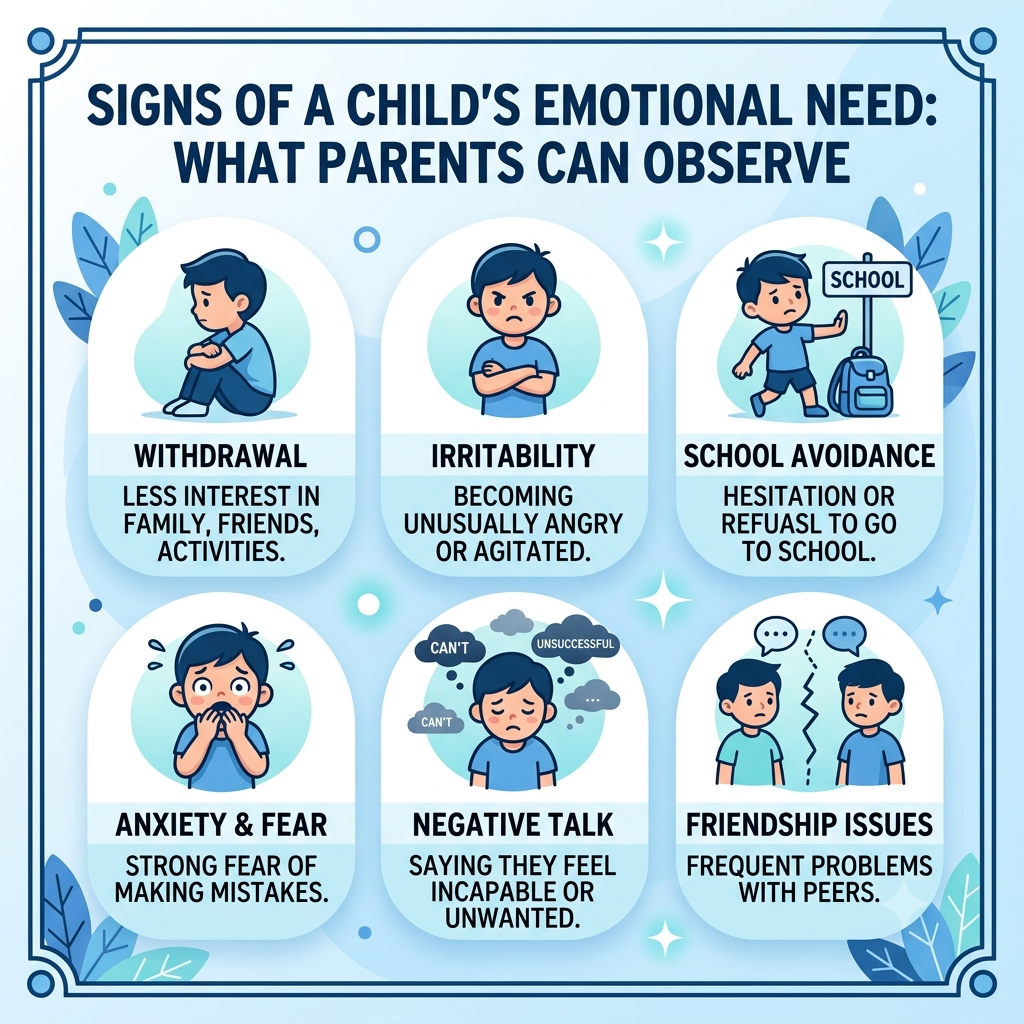
For example, parents may want to have a conversation if a child repeatedly:
- Withdraws from family or friends.
- Becomes unusually irritable.
- Avoids school or particular situations.
- Frequently talks about friendship problems.
- Expresses strong fear of making mistakes.
- Says they feel incapable, unwanted, or constantly unsuccessful.
None of these signs automatically means that a child has a mental-health condition. They simply suggest that the child may benefit from a little more attention and conversation.
Ask questions that invite conversation.
Instead of always asking, “How was school?”, parents can try:
- “What was the best part of your day?”
- “Did anything bother you today?”
- “Was anything difficult?”
- “Did you need help with something?”
- “Who did you enjoy spending time with?”
Open-ended questions can make it easier for children to share details they may otherwise leave out.
Listen before trying to solve
Children do not always need an immediate solution. Sometimes they first need to feel heard.
Listening calmly, acknowledging their feelings, and then discussing possible solutions can teach children that emotions are something they can talk about rather than something they need to hide.
How Can Parents Evaluate a School's Approach to Emotional Wellness?
When comparing schools, parents often look at academics, infrastructure, activities, transport, and fees. Emotional wellness deserves a place on that checklist too.
Parents can ask:
- Can students approach a trusted adult when they are struggling?
- Does the school have a counselling or student-support system?
- Is emotional well-being discussed beyond examination stress?
- Are empathy and respectful relationships encouraged?
- Does the school provide opportunities for students to communicate their concerns?
- How does the school involve parents when a child needs additional support?
There is no single model that works for every school or every child. What matters is whether the school recognises that children's emotional needs are part of their overall development.
Also Read| Hands-On Learning & Exploration
How Grand Columbus International School Approaches Student Wellness
Grand Columbus International School has a dedicated Student Wellness Zone that focuses on students' emotional, mental, physical and social well-being. The school states that it has a professionally trained counsellor to support academic, emotional, and social challenges, along with peer-support and mentorship programmes.

Its official FAQ also mentions an Emotional Wellness Corner, full-time counsellors, and expert-led wellness workshops. For parents evaluating a Top School in Faridabad, these documented support systems can be relevant when considering what a Best School in Faridabad should offer beyond academics.
Emotional Wellness Is Part of Growing Up
Children do not learn emotional resilience in one lesson. They develop it gradually through everyday experiences—handling disappointment, resolving disagreements, asking for help, trying again after mistakes, and learning to understand other people.
That is why emotional wellness should not begin only when something goes wrong. When schools and families make room for healthy conversations and emotional support as part of everyday life, children get more opportunities to develop confidence, empathy, and resilience.
A strong education prepares children not only for the next examination, but also for the many situations they will face beyond the classroom.
For more information on Grand Columbus International School and similar schools, check out this list of the best schools in Faridabad.
 as a preferred source on