







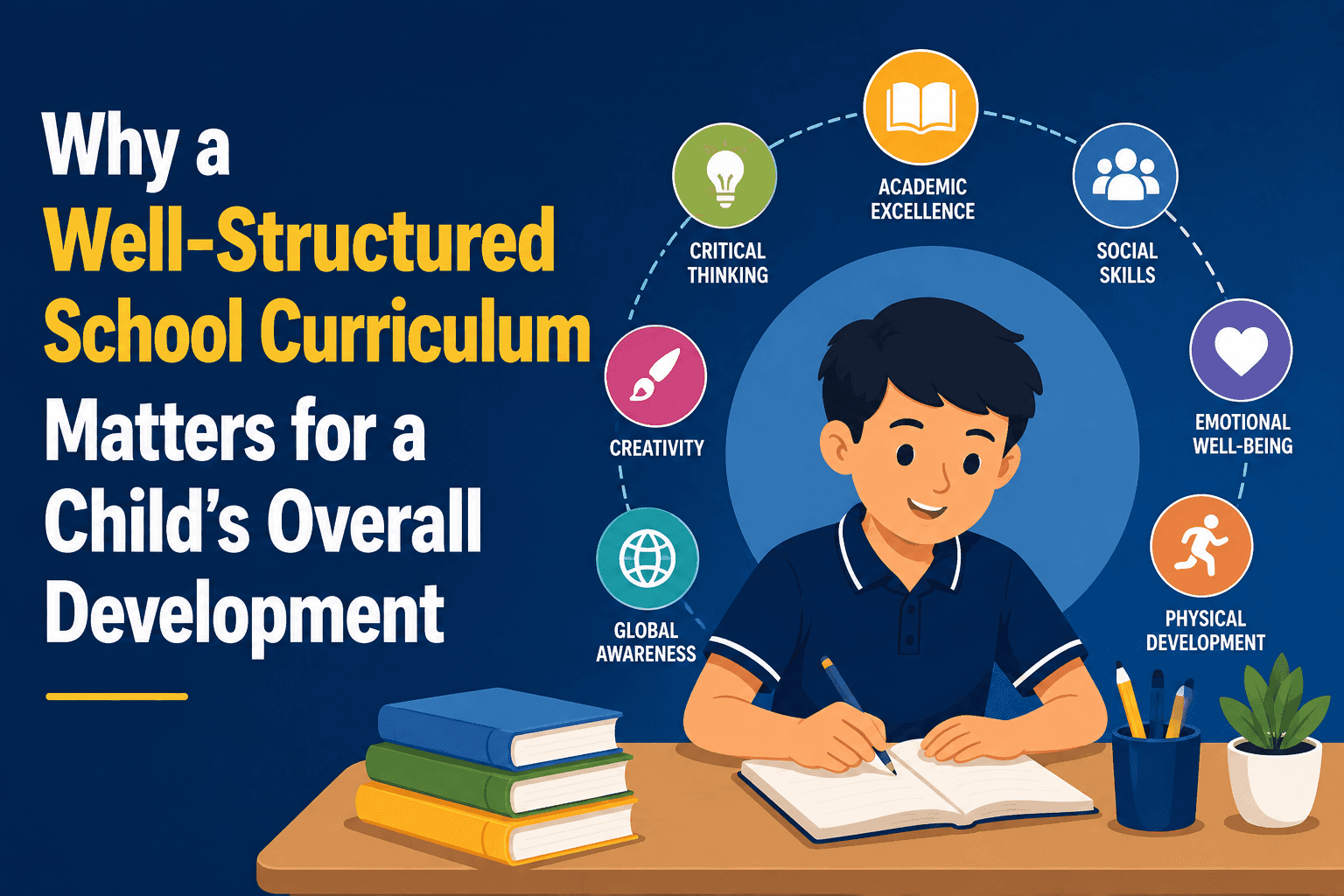

Choosing a school is not only about looking at classrooms, facilities, or examination results. One of the most important things parents should understand is how the school approaches learning. A well-planned curriculum can influence how children understand concepts, develop skills, explore interests, and prepare for the next stage of life. One of the best boarding schools in India, Modi World School, for example, follows a structured academic journey across different stages of schooling while also giving importance to activities beyond textbooks.
What Makes a School Curriculum Important?
A curriculum is much more than a list of subjects that students have to study. It provides a framework for what children learn, how they learn it, and how their progress is assessed.
A good curriculum gives students a clear learning path. Instead of introducing topics randomly, concepts are generally arranged according to the age and learning level of students. Basic ideas are introduced first, and more complex concepts are added as children become ready for them.
This gradual progression is important because children learn differently at different stages. What works for a five-year-old may not work for a teenager preparing for board examinations. A strong curriculum recognizes this difference and changes its approach accordingly.
Learning Should Grow With the Child
Children go through several stages during their school years, and each stage brings different academic and developmental needs.
In the early years, learning can focus on building language, basic numeracy, communication, motor skills, curiosity, and social interaction. At this stage, children benefit from activities that allow them to explore and learn through experience.
As students move into primary and middle school, learning becomes more structured. They begin to develop stronger subject knowledge while also learning how to ask questions, solve problems, work with others, and express their ideas.
The secondary stage brings another shift. Students start thinking more seriously about higher education, careers, examinations, and areas of personal interest. The curriculum therefore needs to provide deeper subject knowledge while helping students develop independence and responsibility.
A curriculum that evolves with these changing needs can make the transition between stages smoother.
Also Read | How to Choose a Residential School
Conceptual Understanding Is More Valuable Than Memorization

One of the biggest challenges in school education is helping students move beyond simply remembering information.
Memorization has its place in learning, but students also need to understand why something happens and how they can use what they have learned.
For example, instead of only remembering the definition of evaporation, students can observe how water changes into vapor, discuss factors that affect the process, and connect the concept to everyday experiences. Similarly, mathematics becomes more meaningful when students understand how equations or measurements can be applied to real situations.
Concept-based learning helps students build knowledge that can be used in unfamiliar situations. It can also encourage curiosity because students begin to see connections between classroom lessons and the world around them.
A Curriculum Should Leave Space for Practical Learning
Not every important lesson needs to happen through a textbook.
Projects, experiments, presentations, discussions, field activities, sports, creative work, and group tasks can all contribute to learning. These experiences give students opportunities to apply classroom concepts instead of only reading about them.
Practical learning can also develop skills that are difficult to build through traditional written assignments alone. Students may learn how to collaborate, communicate, manage time, make decisions, present ideas, and respond when something does not go according to plan.
This is why a balanced curriculum should combine academic learning with opportunities for students to use their knowledge.
Also Read | Why Knowledge Alone Doesn't Build Confidence
The Role of Sports and Co-Curricular Activities
Education is not limited to academic performance. Children also need opportunities to develop physically, socially, and emotionally.
Sports can teach students about teamwork, discipline, patience, and handling both success and disappointment. Creative activities can give them opportunities to express themselves. Clubs and group activities can encourage communication and help students discover interests outside their regular subjects.
These experiences can also make school life more engaging. When students have opportunities to explore different activities, they may discover abilities that are not always visible through conventional examinations.
A well-rounded curriculum therefore needs to recognize that different children can have different strengths.
Preparing Students for the Future
The world students will enter after school is constantly changing. As a result, education needs to prepare them for more than examinations.
Students need strong foundations in subjects, but they also benefit from skills such as communication, critical thinking, problem-solving, collaboration, adaptability, and independent learning.
Technology has also changed the way students access information. Simply knowing facts is no longer enough when information is easily available. Students need to learn how to understand information, evaluate it, connect different ideas, and use their knowledge responsibly.
A future-focused curriculum can introduce these skills gradually, allowing students to become more confident and capable as they progress through school.
How Modi World School Approaches Curriculum

This broader approach can be seen in the academic structure followed by one of the best CBSE boarding schools, the Modi World School, Wisdom City. Its curriculum is organized across different stages, beginning with the Foundation Stage and progressing through the Preparatory, Middle, and Secondary Stages. From Class III onward, the school follows the CBSE-NCERT curriculum, with the academic structure continuing through Classes IX to XII.
The school's early-years programme also focuses on age-appropriate development. Its Jolly Angels programme, for children in the early years, includes areas such as language, numbers, general knowledge, music, art, and physical development.
As students grow older, the learning environment becomes progressively more academic while continuing to provide opportunities beyond conventional classroom study. Modi World School highlights subject choices, specialized coaching, sports, and other opportunities as part of its broader educational offering.
Sports are also treated as part of the school's structured educational experience rather than simply an occasional activity. The school describes an age-appropriate sports curriculum designed to support physical fitness, concentration, motor skills, patience, and teamwork.
For older students, the school also offers programs designed to connect school education with future academic and career pathways. Its YES – Young Entrepreneur School program for Classes 9 to 12 combines schooling with areas such as financial literacy, innovation, soft skills, industry exposure, and integrated preparation for pathways including IPMAT, CLAT, CUET, and CA Foundation.
Choosing a Curriculum That Fits the Child
There is no single curriculum experience that will look exactly the same for every child. What matters is whether the learning structure gives students the right support at the right stage.
Parents can therefore look beyond the list of subjects when evaluating a school. They can ask how concepts are taught, how practical learning is included, what opportunities students have outside academics, how the curriculum changes with age, and whether students are being prepared for life after school.
Ultimately, a strong curriculum should do more than help children complete a syllabus. It should gradually build knowledge, curiosity, confidence, skills, and independence. When academic learning is combined with practical experiences, sports, creativity, and opportunities to explore future interests, school can become a place where children prepare not just for their next examination but for the many stages of life that follow.
To know more about other Boarding schools in India, click on the link below
 as a preferred source on